
Veterans First Program
JOHN SHIRLEY 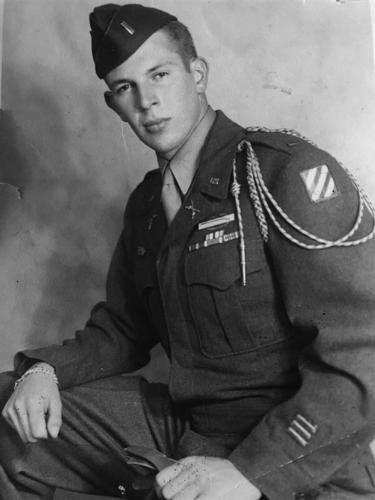
A Life of Service to Country and Community
John Burroughs Shirley lived a life defined by service.
A decorated World War II infantryman, veterinarian, businessman, city councilmember, mayor, community leader, veterans' advocate, and author, Shirley dedicated much of his life to serving others. His story stretches from the battlefields of Europe during World War II to the farms, veterinary offices, City Hall, and community organizations of Livermore, California.
For generations of Livermore residents, he was simply “Doc Shirley.” But his influence extended far beyond his veterinary practice. He helped shape the community's government, advocated for veterans, supported local organizations, and remained involved in civic life for decades.
This is his story.
EARLY LIFE
John Burroughs Shirley was born on December 8, 1924, in Santa Ana, California, and grew up during the Great Depression.
His childhood was spent on a five-acre orange orchard and chicken ranch. His family maintained a large garden and raised approximately 3,000 chickens. His father was a carpenter, while his mother worked as a nurse. The family often shared what they had with neighbors and people in need. From an early age, John understood the value of hard work.
He participated in 4-H and Future Farmers of America (FFA) and spent six years delivering newspapers. His paper route covered roughly 10 to 12 miles, and he later recalled that there was little time for sports because he was always working.
He graduated from Newport Harbor High School in 1942. The world around him was changing rapidly. The United States had entered World War II, and John would soon find himself leaving Southern California for a very different life.
WORLD WAR II
From California to the European Battlefield
John was drafted into the U.S. Army in 1943. After basic training at Camp Cooke in California, he was sent to Fort Sill, Oklahoma, for officer training. He became a sergeant and eventually went overseas as an infantry replacement. He joined the 15th Infantry Regiment of the 3rd Infantry Division, one of the most heavily engaged American units of the war.
John was only 19 years old when he experienced his first combat.
His first major combat experience came during the Anzio campaign in Italy. The fighting was intense, and casualties among his unit were high. He quickly assumed greater responsibility, serving as a squad leader, platoon sergeant, and acting platoon leader. His unit fought its way through Italy and entered Rome on June 4, 1944, just two days before the Allied landings in Normandy.
THROUGH ITALY, FRANCE, AND GERMANY
Following the Allied invasion of southern France in August 1944, Shirley and the 15th Infantry Regiment pushed north through France. The advance was rapid and brutal. His unit traveled hundreds of miles, fighting through towns and countryside as German forces retreated. By December, they had reached the Strasbourg area.
Then the German counteroffensive known as the Battle of the Bulge began. Shirley's unit was redirected south, where it became involved in the fighting in the Colmar Pocket in Alsace, France. It was there that John experienced one of the most traumatic episodes of his military service.
WOUNDED, CAPTURED — AND ESCAPED
During fighting near Bennwihr, France, Shirley's unit came under heavy German attack. He was wounded by tank fire while sheltering in a building. The injury severely damaged his mouth and knocked out teeth. But the danger did not end with his wound.
John was captured by German forces. Rather than remain a prisoner, he escaped captivity. His own account describes striking a German corporal and using the confusion of the battlefield to get away. He eventually found American soldiers who helped him reach safety. He was evacuated to hospitals in France and England, where he recovered for approximately two months. Then, remarkably, he returned to combat.
His wartime experiences were later preserved in his memoir, I Remember: Stories of a Combat Infantryman in WWII.
The National WWII Museum's oral-history collection contains an extensive interview with Shirley in which he personally recounts his experiences from Anzio through France and Germany.
THE FINAL CAMPAIGNS
After returning to the front, Shirley continued with the 3rd Infantry Division as Allied forces advanced into Germany. He fought in and around Nuremberg, one of the major battles of the final months of the European war. His experiences included fighting in ruined cities, confronting German armor and artillery, taking prisoners, and operating under conditions of extreme exhaustion and uncertainty. By the end of the war, John Shirley had participated in multiple campaigns across Europe. His service earned him some of America's highest military decorations, including:
Silver Star
Two Bronze Stars
Purple Heart
He was also later awarded the French Legion of Honor by French President Jacques Chirac for his service in the liberation of France. For John, however, the medals were never the whole story. The people he served with, the friends he lost, and the experiences they shared remained with him for the rest of his life.
COMING HOME
After the war ended, Shirley returned to the United States. Before the war, John had been studying dairy science with the intention of becoming a dairy farmer. But his experiences during the war changed the direction of his life. He decided to become a veterinarian.
In 1948, he enrolled at the University of California, Davis, using the GI Bill to pursue his education. He was part of the first graduating class of the UC Davis School of Veterinary Medicine. John graduated in 1952 with his Doctor of Veterinary Medicine degree. His graduating class was remarkable: nearly every student was a World War II veteran, and the average age of the class was approximately 30. While at UC Davis, John also met Helen, who would become his wife. Together, they would build their family and eventually make their home in Livermore.
ARRIVING IN LIVERMORE
John and Helen moved to Livermore in 1954. Livermore was a very different community from the city it would eventually become. Agriculture remained central to the Valley's identity, and large and small ranches surrounded the growing town.
John saw an opportunity to serve a community that needed veterinary care. He began his practice in a converted garage on their rental property on Third Street. Helen worked as the receptionist and bookkeeper. The practice grew.
In 1957, John built what became Livermore's first animal hospital. There he treated both large and small animals, developing relationships with ranchers and families throughout the Valley. Local ranchers affectionately called him “Doc Shirley.”
ENTERING PUBLIC SERVICE
John Shirley's political career began in Livermore during the 1950s. He served on the Livermore City Council from 1958 through 1966. His interests went well beyond any single issue. During his years in public service, he became involved in questions surrounding:
- City planning
- Community beautification
- Water
- Sewage treatment
- Transportation and railroad underpasses
- The Livermore airport
- Parks
- Schools
- The public library
- Community development
His background as a veterinarian, business owner, rancher-community advocate, and veteran gave him a perspective that crossed many parts of Livermore society.
LEADING LIVERMORE
Mayor
Shirley's service on the City Council eventually led to the mayor's office. His mayoralty came during a period of significant change. Livermore was growing rapidly. The community was balancing its agricultural heritage with new development, increasing population, changing infrastructure needs, and the emergence of the region's scientific and technological economy. Shirley was involved in some of the major issues facing the growing community.
A LIFE OF VETERANS' SERVICE
Even after leaving elected office, John Shirley never stopped serving. He joined the Veterans of Foreign Wars in 1954 and remained active in veterans' affairs for decades. For many years, he participated in Memorial Day ceremonies and the firing squad that honored fallen service members at Livermore-area cemeteries. From 2002 through 2017, he served as commander of the firing squad.
He was also deeply involved with the veterans of the 3rd Infantry Division, eventually serving as president of Outpost 54 for approximately 35 years. The organization supported JROTC programs and scholarships for high school students.
John also became a living connection between Livermore and the history of World War II. He spoke to schools, veterans organizations, civic groups, and community organizations about his experiences. He returned to Europe to commemorate the battles in which he and his fellow soldiers had fought. In France, his wartime service was remembered with particular affection. Shirley became associated with Bennwihr, where he had been wounded during the war, and was honored there decades after the fighting ended.
THE AUTHOR
John did not allow his wartime experiences to disappear into the past. He wrote about them.
His book, I Remember: Stories of a Combat Infantryman in WWII. in Italy, France, and Germany, preserves his personal account of the war.
The memoir describes his experiences as a young infantryman—from his first combat at Anzio through the battles across Italy, France, and Germany.
He also later wrote about another chapter of his life in I Remember: Stories of a Small Town Politician in Livermore in the 1950s and 1960s.
A CONTINUING COMMITMENT TO LIVERMORE
John's public service did not end when he left City Hall. He remained active in the Livermore Rotary Club, serving as its president in 1967–1968. He continued participating in veterans' organizations and community activities. His influence could be seen in organizations, programs, and relationships throughout the Tri-Valley. He was particularly passionate about helping veterans transition into civilian life.
He was instrumental in establishing the Veterans First program at Las Positas College, helping create resources and support for veterans pursuing education. He has a scholarship dedicated to him to help Veterans achieve their education goals. Click here to donate to that scholarship. For John, service was not something that ended when his military uniform came off. It became a way of life.
THE JOHN SHIRLEY COUNCIL CHAMBERS
In 2019, the City of Livermore opened a new City Council meeting facility. The City Council chose to honor one of its former members by naming the chambers after him:
The Dr. John Shirley Council Chambers
At the dedication ceremony in July 2019, then-Mayor John Marchand described Shirley as an “iconic member of our community.” Shirley, then 94 years old, attended the ceremony. The honor recognized more than his time as mayor.
It recognized a lifetime of civic involvement.
A veteran.
A veterinarian.
A former mayor.
A community leader.
A mentor.
A public servant.
The new council chambers became a permanent reminder of his contributions to Livermore.
THE LEGACY OF DOC SHIRLEY
John B. Shirley died in Livermore on December 22, 2021, at the age of 97. But his story did not end with his passing. His legacy remains visible throughout the community he served. It exists in the animals he cared for. In the veterans he supported. In the students he encouraged. In the civic projects he helped advance. In the people who knew him as a veterinarian, a mayor, a neighbor, a friend, or simply “Doc.” And it exists in the council chambers that now bear his name.
The Rotary Club of Livermore established the John Shirley Exceptional Service Award, recognizing the same principle that guided much of his life: service to others. His family also established a scholarship in his memory for a student who exemplifies “service-above-self.”
REMEMBERING JOHN SHIRLEY
There are many ways to measure a person's life. By the positions they held, the awards they received, organizations they led, or the buildings that carry their names. John Shirley had all of those things. But perhaps the simplest way to understand his legacy is to look at what connected every chapter of his life.
He served.
He served his country when he was a young man, and his patients as a veterinarian. He served his neighbors as a city councilmember and mayor. He served veterans by keeping their stories alive. He served his community through Rotary, veterans organizations, education, and countless other efforts. And he continued serving long after most people would have considered their work finished.
John Shirley's life connected the battlefields of Europe with the streets of Livermore. His story is therefore not only the story of a World War II veteran, or a veterinarian, or a mayor. It is the story of a man who spent nearly eight decades turning the lessons of one generation into service for the next.
See more of Dr. John Shirley and his life.
John Shirley
1924–2021
Soldier. Veterinarian. Mayor. Veteran. Community Leader.
A life of service to country and community.